
The first time I came across the name James Baldwin was when we were discussing Love & Queer Literature sometime in February. I went through that post again [in preparation for writing this one] and I’m surprised to note that though Giovanni’s Room is mentioned in it, it didn’t really make a dent in my subconscious at the time.

Since the past year and a half, the one thing I have truly enjoyed doing is scrolling through Goodreads to find my next book. Usually I can trace back how I came across one but for the life of me, I don’t know how or where I came across Giovanni’s Room and why I decided that this book would be a perfect, short and easy read to tide me over my reading funk.
Well…despite being a classic, what struck me first is how immensely readable this book is. Even though it starts with David, the protagonist, standing in front of a window, contemplating how his life is falling apart, before it meanders through to his early childhood, his stint in the army and then fleeing halfway across the world to “find” himself, to his affairs and then coming back to that window, nowhere do you get lost or do you feel like you don’t know what is happening.
I was thinking about the themes that Baldwin has explored in this book and one that was striking is shame and how it renders David incapable of loving anything or anyone. There is a beautiful line in the book:
Not many people have ever died of love. But multitudes have perished and are perishing every hour – and in the oddest places – for the lack of it.
David’s shame of his own self, and his need to be “a man” and to not deviate from being a man are so strong, even if there’s beauty in front of him, he is unable to see or enjoy it.
Giovanni on the other hand is the exact opposite of David. He wears his heart on his sleeves. He thinks David and he can have a good life despite being two men. He weeps, he demands, he cajoles. There is a scene where Giovanni, after having being fired from his job, collapses in David’s arms and David thinks why he had ever thought that Giovanni was strong.
He so despises weakness and anything that stains his reputation of “being a man” he’d rather be in a miserable relationship with a woman than allow himself to be happy. Even though he leaves America and travels to Paris to get away from labels, he’s entrapped by them. In a way, he does find himself – he realizes that what he really needs is not freedom but chains. He says right in the beginning:
Nothing is more unbearable, once one has it, than freedom. I suppose this was why I asked her to marry me: to give myself something to be moored to.
What really leaves you breathless [and I’m sorry if this is spoilerish] is that as a reader, you’re never left off the hook. Even when you read Metamorphosis by Kafka, once Gregor Samsa dies and the family moves on, you have a sense of peace, a sense of closure, a sense of a chapter closing and a new one opening beyond the book. But here, there’s no end to the self-loathing David feels. There’s no relief and there’s no end to the tunnel.
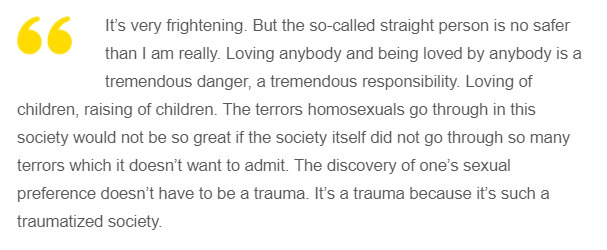
I leave you with this excerpt from an article I read on Brain Pickings:
This post is a part of Blogchatter Half Marathon.


 tales of Suchita
Leave a comment