
In eleventh standard we were introduced to a subject called Environmental Education – EED for short. It was to be a part of our compulsory subjects which meant while calculating our final percentage in twelfth using 5 out of 6 subjects, of those 5, English and EED had to be included.
The only thing I remember from those periods is that our teacher was really pretty, we really, really, really bullied her because she was teaching us a subject we had no interest in and in no way would help us out in our careers and Kyoto Protocol. I had to look it up to remind myself of the nuances but I do remember that Kyoto Protocol had something to do with emissions and a pledge to reduce those.
Environment as a topic has never really been sexy, especially in school. Now, well, now it has become a matter of life and death and quality of life. But then, when we should have been learning more about what we as students could do to help our environment, we were busy passing chits in class and creating a general nuisance of ourselves.
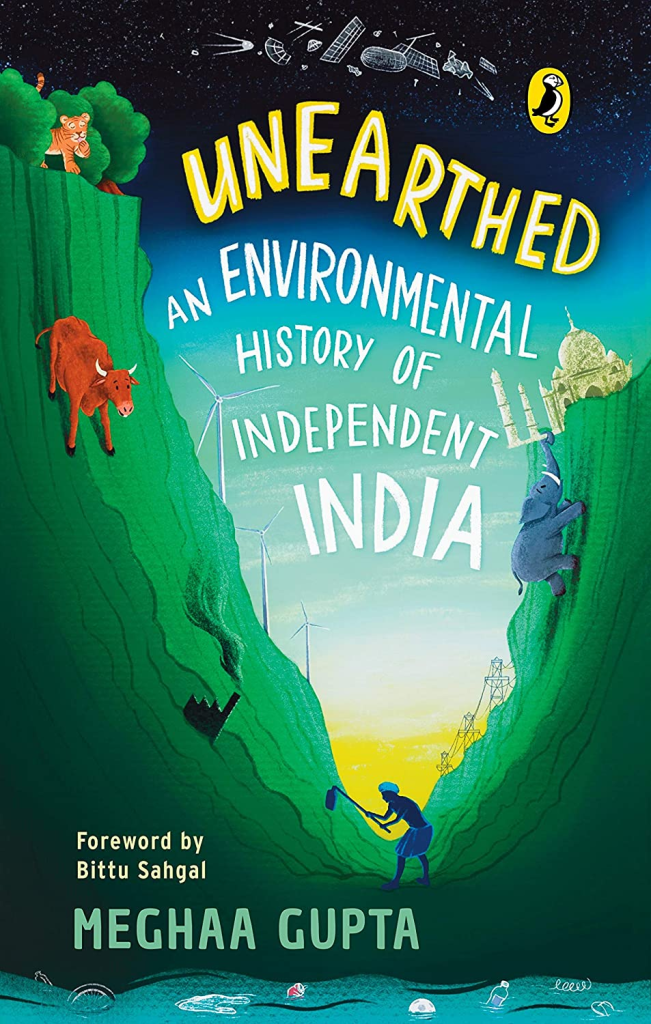
This book, Unearthed, I picked up from a blogger’s list of books on environment for children. I’m not a big fan of nonfiction books. In fact, I have noticed a rather strange pattern of me stopping as soon as I would reach 50%. But I picked this book up because of its subtitle which says: The Environmental History of Independent India.
This book, at about 250 pages, is immensely readable and because it’s written for children, it has some amazing posters, fun facts, activities, and humour I was not expecting! Some of the headings and sub-headings were hilarious and I realized how important these little witticisms are because the book is bleak. It makes you feel a bit helpless because it shows you just how complex “saving” the environment is. Even if we take two steps forward, we take at least ten backwards.
Some of the things you’ll read will make your blood boil: like how there isn’t enough land for elephants to walk and go through their daily lives. How some species of flora and fauna are already extinct because of humans and our inability to prioritize issues that help our survival. I do sometimes wonder how we became the apex predators. We’re the only species that kill each other. How have we survived this long?
But it’s not all bleak. Unearthed is an excellent education into the complexity of the issue. There are examples of how experiences in the childhood, of watching rain being collected in a utensil, led to someone turning into an activist. There is an explanation of where a practice began, why it began that way and what are the repercussions we’re seeing now.
The book’s final words are quite something:
The stage has been set for an epic combat and the story will continue to evolve through our lifetime.
The book lets you know that you and I can help in this fight in our own little ways. Everything we do can create a ripple effect and Carl Sagan said it best:
Look at that dot. That’s here. That’s home. That’s us.
And we’re the only ones who can do something about it.


 tales of Suchita
Leave a comment