
Identity as a concept fascinates me. I didn’t like the thought that someone else could inform the way I lead my life. I liked the thought that I alone am responsible for my thoughts and actions.
It has taken me a while to accept that my interactions with the world have and will continue to have an impact on who I see myself as a person.
I had not expected such a lesson when I decided to jump into studying Dante’s Divine Comedy. I started it because it was a piece of literature and thanks to the two Shakespearean plays I had studied and enjoyed studying in school, I knew I would enjoy it too. I had not anticipated the lessons I would learn, the notes I would make, the money I would have to pay to retain access to the study material and the certificate I wouldn’t earn because I was short 2% of the passing grade.

I of course knew about the concept of Inferno and the circles of hell and the popular quote: abandon all hope ye who enter here. But what I wasn’t prepared for was how I would see Dante’s journey through Inferno, Mount Purgatorio before reaching Paradiso as a journey of a creative. In that sense, Inferno would be a creative’s hell, filled with doubt and loathing, before understanding came that it is you who has trapped you in this hell and not “the other.” Mount Purgatorio would be the climb you have to take where you shed your baggage and realize the truth: you are as capable as you allow yourself to be. And Paradiso would be the point where you create, and as you create, you’re in paradise.
The thing that amazed me about the climb of purgatory was that while it was you who was serving the penance, it wouldn’t be possible, or nearly as smooth, if there weren’t people praying for you or your success. It reminded me of the celebration Día de Muertos (the Day of the Dead). It reminded me that I’m standing on the shoulders of a lot of people.
Though “journey of the creative” is obviously not the scenario that Dante wanted his Comedy to be read in, I had so many more interpretations of it as I went through it. What really, really, impressed me was this was written in the fifteenth century and yet it is so relevant today. Throughout the study process, I kept thinking that the Comedy is a guide on how to be human and how not to be a human. How easy it is for us to give up control on our lives and blame someone else. I had to remind myself repeatedly that I wasn’t reading a gospel, but a piece of literature; it was that consuming as I read it.
Every time I have studied literature, the professors have always emphasized the importance of the opening line. The first three lines of Divine Comedy are:
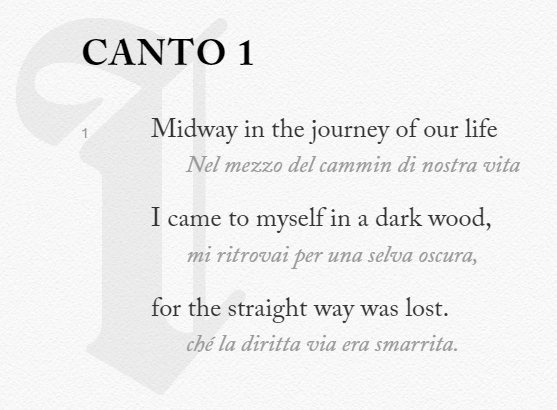
The poem begins “nel mezzo” which means “in the middle.” Just like Dante’s journey through the realm of the dead begins in the middle, our stories also begin in the middle. Maybe because it is in the middle that you realize that you can do nothing of the past and that the future is uncertain. It is in the middle that hope is born that despite what happened yesterday, tomorrow may be better. And to make it better, we begin now, right where we are, nel mezzo.
I’m taking my blog to the next level with Blogchatter’s My Friend Alexa. For the next 1 month, I’ll be sharing some of my favourite bookish memories; hence the title Reading Tales.


 tales of Suchita
Leave a reply to Harjeet Kaur Cancel reply