Hello. This is a bit of a spoilerish review. If you plan to read the book, this may cloud the way you read it. If you don’t plan to read the book but are curious why the internet has such mixed reviews of it, read on!
I picked up this book for obvious reasons. I read the news that Han Kang had won the Nobel Prize in Literature in 2024. I went through a list of her books and while all of them sounded intriguing, this one captured my attention the most.
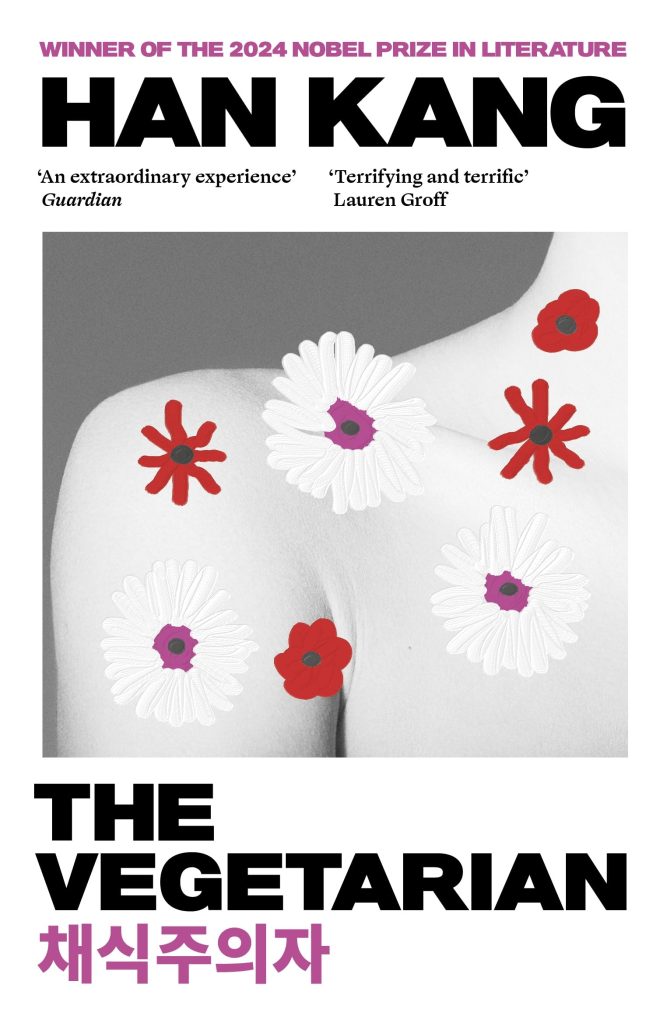
I think when you read a book that you have been anticipating and reading so many reviews about, your experience of it becomes diluted and muddied. There are keywords mentioned in the blurb that give context to Kang’s words and half the time I wasn’t sure if I was genuinely making a connection or was it just these outside words that were giving me context that didn’t actually exist.
This is one of the reasons of my rating: Hmmm (or 3.5 stars). The other reason is I shouldn’t need such cues to be able to understand what the book is about.
Perhaps the most helpful keyword was this book is Kafka-esque and I could draw parallels between The Metamorphosis and this book.
Here’s my opinion of it: Yeong-hye has never had any control over her life. She is a product of her society, gender and upbringing. She does everything that is expected of her. Until she sees a grotesque dream and decides to turn into a Vegetarian.
To me, who is an occasional non-vegetarian, it may seem like a small rebellion but to a society that is primarily non-vegetarian, it is a huge rebellion. From there on, she takes as much ownership as she can of what she eats or doesn’t, which translates to having ownership of her body.
She is a part of society though. And this society, in its “we love you, this is for your best” attitude, interferes with her chosen path. She still manages to find ways to defy them. It may seem childish at first glance, her wanting to turn into a tree, but it is probably her act of war.
After all, a tree is an individual but is also a part of a community and it is interesting that she wants to become one. No one questions a tree, no one tries to persuade a tree to do something that is not in its nature. Even if you cut down a tree, it finds a way to grow again. This feeling is perhaps what Yeong-hye is chasing.
Another aspect of the story that I noticed was loneliness. We kill parts of ourselves to fit into society, to belong, so we’re not alone. This is something In-hye, Yeong-hye’s sister and the eldest child, does. Even when her husband leaves her and her sister has been committed, she continues to live in her cage of obedience and domesticity because she doesn’t know how to get out of it. She says it in her own words that she’s jealous of her sister because Yeong-hye is beyond these limits and chains.
Then there is In-hye’s husband. Who despite being an artist, is so convinced of his own mediocrity and inundated with his insecurities that when he feels he has made a masterpiece, he wants to immediately kill himself. When that fails, he hides and isolates himself.
Unlike in The Metamorphosis though, there is no light at the end of this tunnel. Metamorphosis, when seen in the light of The Vegetarian, is actually a hopeful book, shocking as that is.
Yes Gregor Samsa turns into a beetle but his choices aren’t questioned. Gregor, as a man, is afforded respect, despite turning into a beetle. The same respect is not extended to Yeong-hye. In fact, she is constantly beaten (physically, emotionally and mentally) to bring her to heel. But she doesn’t obey.
Maybe that’s why this book is not hopeful as In-hye, Yeong-hye and their mother, are all ignored, as women often are, when they try to exercise their autonomy.
If you have read the book, what was your experience of it? If not, would you read it? Let me know in the comments.


 tales of Suchita
Leave a reply to Matheikal Cancel reply