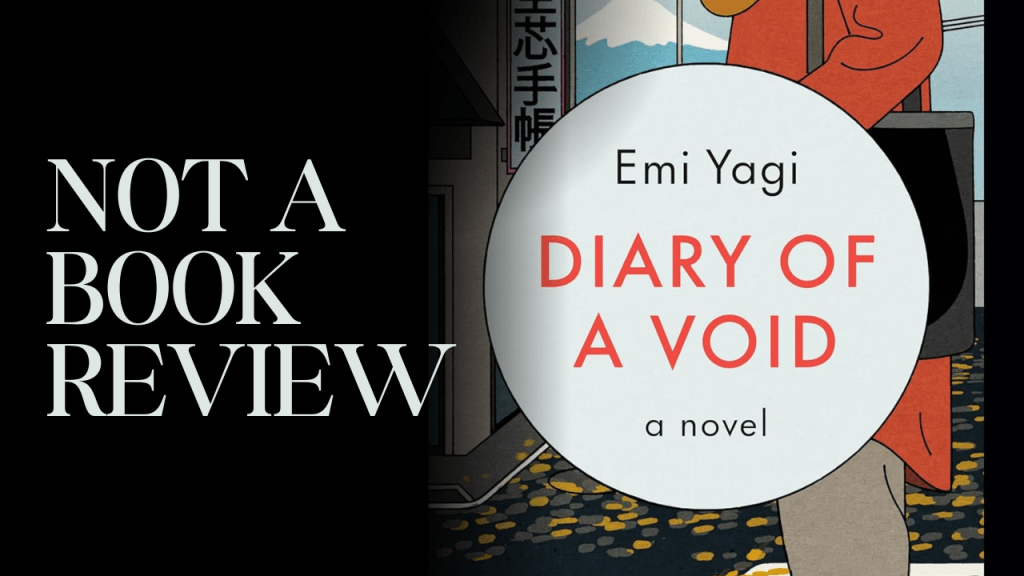
It’s good to know that not all books coming out of Japan are based on bookstores or have cats on their covers! Jokes apart, I picked up Diary of a Void by Emi Yogi (translated by David Boyd and Lucy North) because of its very unique premise: a woman faking a pregnancy because she is tired of the everyday casual sexism she faces at work.
Shibata works in an office that manufactures paper cores. She is the only female in a male-dominated workspace and since its Tokyo, Japan which is perhaps as patriarchal as India, the job of cleaning, organizing, etc by default falls on her. Even though that’s not her job, she seems to be the mother, sister, daughter, secretary, cleaning lady, etc of the entire office.
One day, she has had enough and she tells her section head that she can no longer clean the meeting room that reeks of stale coffee and cigarettes because she is pregnant. It’s a lie but Shibata shows zero guilt at using this to get herself a lot of “perks.” Perks like going home on time. Or not taking on extra work because of her delicate condition. Or access to space that was previously denied her because she has a special pass that declares she is pregnant.

I have been thinking about this book since I finished it and every time, I find a new facet to it. Like how Shibata has to lie for the men in the office to realize oh, they do know how to clean a microwave. Or how they take up the distribution of free gifts they keep receiving from clients (which has always been Shibata’s unsaid job) because they want to help relieve her burden.
It was so interesting to see how the world around Shibata changed simply because her status changed from a single woman to a pregnant mother.
Loneliness and urban living are other aspects of the story that are done beautifully. Just going through Shibata’s routine of getting dressed for work and then coming back to an empty home gives a whole meaning to we’re all alone in the world. She has friends, she has family but in the end, she is alone.
At one point in the novel, Shibata says that she is so used to her loneliness, she has become intolerant to people’s useless questions and noise. She also says she is afraid of losing her identity if she continues to be alone. It made me think that when we are not answerable to anyone but ourselves, we have little to look forward to. What do you do when you no longer have to fight to be who you want to be? When there are no more checklists of society to fulfill, and you’re truly “free,” how do you manage this freedom?
Shibata stays committed to her lie of pregnancy and I was really interested in seeing how this farce of hers would end. It was unexpected and while I wasn’t sure how to take the ending, I get it now. This was an immensely readable book, quick since its about 200 pages, but I loved that it made me think so much, and even as I finish this review, I have so many thoughts (spoiler-filled thoughts) that I cannot put here.
I want to leave you with a quote:
How many other imaginary children were there in the world? And where were they now? What were they doing? I hoped they were leading happy lives.
Is there a book you loved the more you thought about it? This was one such read for me. I would love to know what book did that for you.
This post is part of Bookish League blog hop hosted by Bohemian Bibliophile.



 tales of Suchita
Leave a reply to Tulika Cancel reply