
Though I was introduced to the world of The Lord of the Rings when I was 14, I have had a love-hate relationship with the books since then. I first read them when I was 21 and then tried them again when I was 30. Both the times, I was dissatisfied with the books and especially with the writing.
Why were writers so obsessed with how Tolkien wrote?
Why were LOTR “purists” so upset with what Peter Jackson did with the movies?
Well. Let’s just say…I get it now.
I recently heard the audiobooks on Storytel narrated by Andy Serkis, the actor who played Gollum in the movies. A side note…God bless Andy Serkis for his voice and how he can act with it. He created a different voice for each of the characters and I am in awe of him.
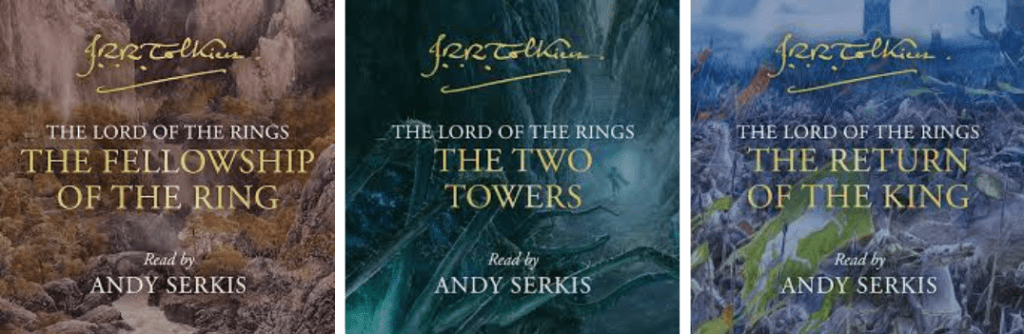
Experiencing Tolkien’s world through audiobooks helped answer those questions. And now, I must impart that wisdom to you.
Here are 5 writing lessons I learned from Tolkien.
#1. Every hero’s journey does not need upskilling
Arguably, LOTR has two protagonists: Frodo and Aragorn. They are complete characters when you meet them in the beginning of the book. They go through trials, they break, they cry, they lose all hope and then become a source of hope for the people around them. And yet, there is very little growth – emotionally or skill-wise – that either of them goes through on their quest of destroying the Ring.
And that was very interesting for me to read especially when almost every quest-type fantasy book I have read has some amount of upskilling or mentor-mentee relationship that gets thrown in.
#2. Using pauses and levity for reader relief
I first noticed how Tolkien deliberately adds pauses and levity after an intense scene when I was listening to the Fellowship. One of the most talked about scenes came in, the one where our hobbits meet Tom Bombadil. And yes, I felt like it completely derailed the pace of the book but then I noticed that the books are sprinkled with such pauses and levity.
LOTR is quite a bleak, hopeless and dark book. The evil is always dogging our feet and when our heroes break, I felt that loss of hope too. So, it was interesting to find something to laugh about despite knowing that any time the Nazgul could fly down, kill our heroes and take the ring back to its master.
#3. Using memory, ruins, conversations instead of exposition dumps
Fantasy is infamous for exposition dumps and as a writer, I am always looking for tricks to do this in a creative way. There is a conversation that Gandalf and Pippin have for example, after the Palantir and they’re on their way to Minas Tirith. To distract Pippin, Gandalf starts talking about the ruins they pass through. And I thought it was such a clever way of showing the depth of the world.
Another trick that Tolkien uses is memory. Since LOTR is set in the third age, the previous two ages are shown through the memories of the elves, the caves of the dwarves and of course what Aragorn has seen.
#4. You don’t always need big secret reveals or omission of information to create drama or tension
An interesting peculiarity I noticed in LOTR was, how information is simply shared. Right in the beginning, when Gandalf and Frodo are talking in the Shire, there is no sudden knock on the door that interrupts the flow. They are given the time and space to really talk about the ring, what it means, how Gollum is intertwined with its fate, etc.
And yet, knowing the information creates the same kind of dramatic tension in me as a reader because I know what’s coming and that makes me curl into myself.
#5. Using characters to build other characters
I especially enjoyed how Merry and Pippin grow from comic relief characters to almost strategic partners once they return to the Shire and find it overrun by Orcs. I also liked the little love story between Faramir and Eowyn and just how her character was built though she has such little story time.
What I found most interesting was how Aragorn’s greatness and nobility was built by the other characters. We know who he is not because he says it, but because the characters around him show him deference – sometimes even without knowing why. They look at his face, the way he carries himself and simply know he is important.
If I ever find the wherewithal, I would love to do character sketches on Aragorn, Eowyn and Frodo because of how interesting they are.
Anywho, time for a question: is there a book that has taught you about writing?
This is written as part of #BlogchatterHalfMarathon


 tales of Suchita
Leave a reply to V. Ananya Cancel reply