
I have always been proud of the fact I’m not a genre-specific reader. I will read anything, as long as its sample on Kindle incites my interest. Since most samples are about 10% of the total page count, I have found this to be a fair way to judge books before I jump into them.
And yet, nonfiction is one genre I have only been able to dip into. While reading At the Existentialist Café, I realized I had been looking at this genre all wrong. Since most nonfiction books I see on socials come with the warning – best books to read to be successful in life – I steer clear of them. It feels like there are only 10 books in this genre that everyone seems to be talking about and swearing by.
This was my mistake and I would like to apologize to this genre for taking so long in warming up to it.
Before this book, I had a vague idea thanks to Wikipedia, what existentialism meant. I liked its messiness and its attempts to make sense of the human condition. I liked it did not have any easy answers or a god you could blame all your problems on.
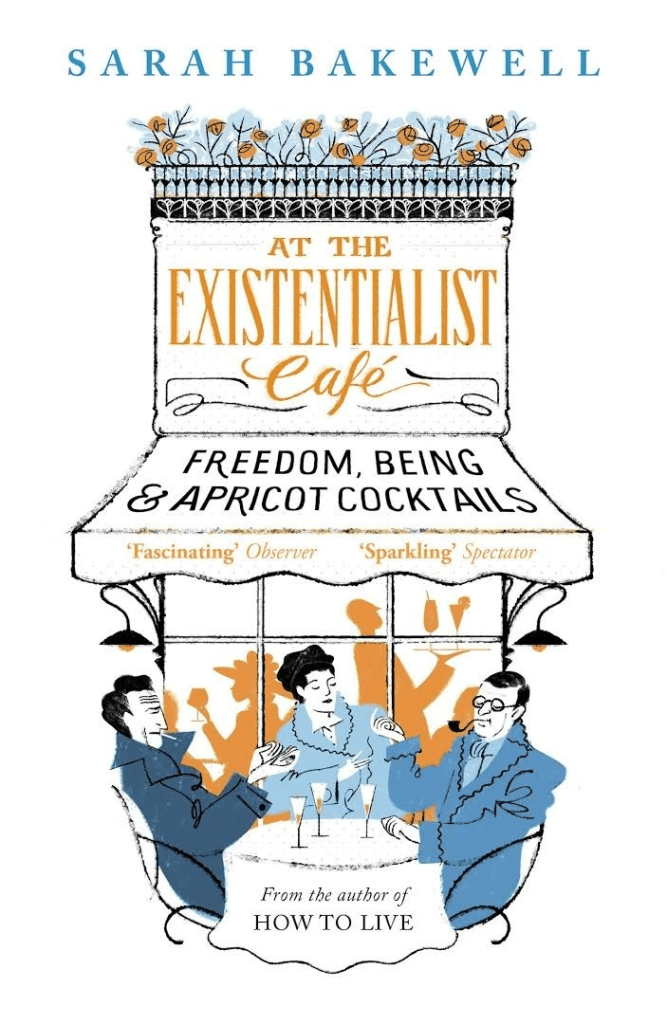
After reading this book, I’m even more in awe of this philosophy. Existentialism is deeply personal as the book showcases by talking about the many proponents of this philosophy (Sartre, Beauvoir, Merleau-Ponty, Camus to name a few) and how it came to be for each of them. How the context of their sex, nationality, the World Wars and their own political inclinations defined their thoughts and consequently their philosophy.
On the other hand, existentialism is so much more than just you as a person because you exist in context to something else. Like one of the fifty-two highlights I have from the book says,
What Being does the boat have for me?
The line made me think that unless I contemplate a boat, it does not exist. As soon as I see it or engage with it, it gains value for me. Yet, a boat’s being does not depend on my attention. It exists despite my inattention.
While the book is a rich cocktail of existentialist philosophy, it really got its claws into me when it started to delve into the World War affecting not only the philosophy of how one must live in the world, but also our philosophers.
What is so detestable about war is that it reduces the individual to complete insignificance.
It was an experience reading about the war from the point of view of ordinary people as they tried to balance life between “submission and resistance.”
Few people will risk their life for such a small thing as raising an arm – yet that is how one’s powers of resistance are eroded away, and eventually one’s responsibility and integrity go with them.
I was right there, walking the streets and visiting cafes with Sartre and Beauvoir in Occupied France as they tried to find meaning in life, before and after the war as it upended everything they thought to be true and just.
As Sartre wrote in response to Hiroshima, humanity had now gained the power to wipe itself out, and must decide every single day that it wanted to live.
As someone who is going through her version of “submission and resistance” thanks to our political climate and the way religion has become this behemoth in every conversation, reading this book was like a balm to my senses.
Apart from context, another principle that defines existentialism is freedom.
Existentialism in practice, defined by the two principles of freedom and companionship.
Sarte wrote that even though we are freedom, we’re afraid of it. If we were truly free, we’d have to be responsible for all the masks we hide behind, the mess we have made of our life, and the inauthenticity we pretend to thrive in. It’s easier to pretend our hand is tied behind our back rather than admit it is we who have tied it.
Some ten years ago, I had wanted to study philosophy but I hadn’t been able to find the right e-course or the time to do justice to it. I’m glad I waited for this book to impart its secrets to me.
This book gets a “thank you for existing” rating from me and is an instant favourite. I’m glad I allowed myself the time and space to savour this book over three weeks.
I will now ask a question I hadn’t thought I’d ask: any nonfiction book recommendations? As long as they’re not Atomic Habits, Sapiens or Becoming, I’ll be glad to increase my TBR.
This post is part of Bookish League blog hop hosted by Bohemian Bibliophile and #ReadingWithMuffyChallenge hosted by Shalini for the prompt a book from your TBR.


 tales of Suchita
Leave a reply to Ninu Nair Cancel reply