Not a book review: At the Existentialist Café

I have always been proud of the fact I’m not a genre-specific reader. I will read anything, as long as its sample on Kindle incites my interest. Since most samples are about 10% of the total page count, I have found this to be a fair way to judge books before I jump into them.

And yet, nonfiction is one genre I have only been able to dip into. While reading At the Existentialist Café, I realized I had been looking at this genre all wrong. Since most nonfiction books I see on socials come with the warning – best books to read to be successful in life – I steer clear of them. It feels like there are only 10 books in this genre that everyone seems to be talking about and swearing by.

This was my mistake and I would like to apologize to this genre for taking so long in warming up to it.

Before this book, I had a vague idea thanks to Wikipedia, what existentialism meant. I liked its messiness and its attempts to make sense of the human condition. I liked it did not have any easy answers or a god you could blame all your problems on.
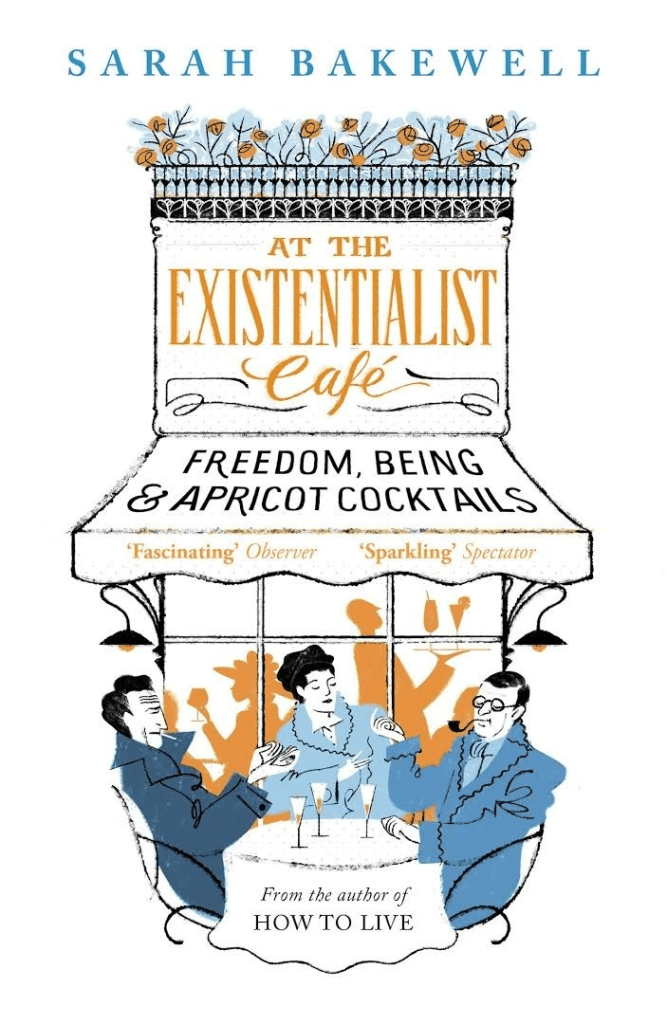
At the Existentialist Café: Freedom, Being, and Apricot Cocktails by Sarah Bakewell
Genre: Philosophy, Non-Fiction

After reading this book, I’m even more in awe of this philosophy. Existentialism is deeply personal as the book showcases by talking about the many proponents of this philosophy (Sartre, Beauvoir, Merleau-Ponty, Camus to name a few) and how it came to be for each of them. How the context of their sex, nationality, the World Wars and their own political inclinations defined their thoughts and consequently their philosophy.

On the other hand, existentialism is so much more than just you as a person because you exist in context to something else. Like one of the fifty-two highlights I have from the book says,

What Being does the boat have for me?

The line made me think that unless I contemplate a boat, it does not exist. As soon as I see it or engage with it, it gains value for me. Yet, a boat’s being does not depend on my attention. It exists despite my inattention.

While the book is a rich cocktail of existentialist philosophy, it really got its claws into me when it started to delve into the World War affecting not only the philosophy of how one must live in the world, but also our philosophers.

What is so detestable about war is that it reduces the individual to complete insignificance.

It was an experience reading about the war from the point of view of ordinary people as they tried to balance life between “submission and resistance.”

Few people will risk their life for such a small thing as raising an arm – yet that is how one’s powers of resistance are eroded away, and eventually one’s responsibility and integrity go with them.

I was right there, walking the streets and visiting cafes with Sartre and Beauvoir in Occupied France as they tried to find meaning in life, before and after the war as it upended everything they thought to be true and just.

As Sartre wrote in response to Hiroshima, humanity had now gained the power to wipe itself out, and must decide every single day that it wanted to live.

As someone who is going through her version of “submission and resistance” thanks to our political climate and the way religion has become this behemoth in every conversation, reading this book was like a balm to my senses.

Apart from context, another principle that defines existentialism is freedom.

Existentialism in practice, defined by the two principles of freedom and companionship.

Sarte wrote that even though we are freedom, we’re afraid of it. If we were truly free, we’d have to be responsible for all the masks we hide behind, the mess we have made of our life, and the inauthenticity we pretend to thrive in. It’s easier to pretend our hand is tied behind our back rather than admit it is we who have tied it.

Some ten years ago, I had wanted to study philosophy but I hadn’t been able to find the right e-course or the time to do justice to it. I’m glad I waited for this book to impart its secrets to me.

This book gets a “thank you for existing” rating from me and is an instant favourite. I’m glad I allowed myself the time and space to savour this book over three weeks.

I will now ask a question I hadn’t thought I’d ask: any nonfiction book recommendations? As long as they’re not Atomic Habits, Sapiens or Becoming, I’ll be glad to increase my TBR.


This post is part of Bookish League blog hop hosted by Bohemian Bibliophile and #ReadingWithMuffyChallenge hosted by Shalini for the prompt a book from your TBR.

50 responses to “Not a book review: At the Existentialist Café”

  1. Hopped on here from your Best reads post. Since I haven’t read Camus, that’s where I’m going to start and then will get to this one. It sounds so very interesting but I wonder if I have the mindspace for deep philosophy. But then again, if not now, when? So yeah, it’s definitely on the TBR.

    Liked by 1 person

    1. The Stranger by Camus is where you should begin. It’s short and so marvellous. The thing about Existentialist Cafe is, if you read it slowly (like 1 chapter a day) it won’t feel heavy. Sarah has done a commendable job of making it accessible.

      Liked by 1 person

  2. Woof woof! 🐾 Thank you for paw-ticipating in the #ReadingWithMuffy challenge! Your entry has been paw-sitively noted.

    I agree with what you said about non-fiction books. But I kinda loved this one. The quotes you shared make me want to pick it up asap! Maybe, I will 🙂

    Liked by 1 person

    1. Its quite an impressive read 🙂

      Like

  3. Agree with you on the non-fiction picks. Apparently, there are very few worth reading (with everyone reading them, of course) and the genuinely good ones barely get noticed. I am quite intrigued reading your discussion on At the Existentialist Café. Checking it out for sure.

    Liked by 2 people

    1. Thank you Ritu. Hope you enjoy it if you decide to pick up the book!

      Liked by 1 person

  4. All the quotes you shared are awesome. But the one about war should be able to stop anyone trying to think of doing a war. 🤩

    Liked by 2 people

    1. Thanks Sivaranjini.

      Like

  5. what a beautiful cover and while i too would probably not have picked up this book, however, once you started talking about your thoughts when reading this book, whether about the boat or the people in WWs .. it piqued my interest . I am going to check this out too.

    Liked by 2 people

    1. So happy to hear that! Hope you like the book if you choose to pick it up ☺️

      Like

  6. I like the way you depicted the nonfiction genre. I have been relishing nonfiction books for some time and it is great to read about memoirs that indirectly inspire the reader to introspect and change their way of living.

    Liked by 2 people

    1. That’s true. Books can be really inspiring 😀

      Like

  7. As an admirer as well as staunch adherent of Existentialism, I’d love to read this book. You’ve made it all the more endearingly with your introduction to it.

    Liked by 2 people

    1. Thank you! I hope you enjoy the book if you pick it up 😄

      Like

  8. Kanchan Singh Avatar
    Kanchan Singh

    Hey there, fellow eclectic reader! Your journey with nonfiction mirrors my own, and I totally get where you’re coming from. It’s easy to get caught up in the hype surrounding certain genres, especially when they come with promises of unlocking the secrets to success or happiness. But hey, who needs a one-size-fits-all approach to life, right?

    Liked by 2 people

    1. Or a one size fits all approach to reading 😊 the hype half the time keeps me away. But I’m learning slowly 😄

      Like

  9. Welcoming your idea to trying to read Non fiction, here are my choice of books;
    * Tales of a Voyager, Translated by Nazes Afroz. Author Syed Mujtaba Ali
    * Like fine wine By syeda Imam
    * ZIKR- BY Muzaffar Ali
    *Another India by Chandan Gowda

    Liked by 2 people

    1. Thank you so much for the recommendations Anuradha.

      Like

  10. One thing That I got to know today is that I match one thing with you. Checking sample pages before buying a book (KIndle) it gives a fair idea about what the content will be worth reading or not. Non fiction offers altogether a new approach to observe things around us and in many cases help to discover the undiscovered things so far. Suchita you indeed have a different taste of reading and that makes you unique.

    Liked by 2 people

    1. Help to discover the undiscovered – that sounds lovely. And thank you so much for the compliment!

      Like

  11. I think with a turbulent Afghanistan, Ukraine and Gaza, we are still in the same boat. I lread Beauvoir, Sartre and Camus in my 20s, so don’t remember much, but wars in any decade are the same. And I guess, the philosophy remains the same.
    Non-fiction reco:s if you like real life heroism and dilemmas-Madam Commissioner: The Extraordinary Life of an Indian Police Chief by Meeran Chadha Borwankar; if you want philosophy-Sri Aurobindo: The Life and Teachings of a Revolutionary Philosopher by Roshen Dalal and if you want technology–AI Rising: India’s Artificial Intelligence Growth Story by Leslie D’Monte and Jayanth N Kolla .

    Liked by 2 people

    1. So true, times may change but war does not. Thank you for the reccos Ambica 🙂

      Liked by 1 person

  12. So rightly said, our non fiction world is spun around home sapiens, atomic habits, the subtle art of and the likes that it has created this distaste for the whole genre. I kept pushing aside Becoming for the exact reason but fell in love with the book once I opened it. Loved reading your post on this book, and the cover is so delightful. I am definitely adding this to my TBR.

    Liked by 2 people

    1. Distaste is the right word! And I hope you enjoy the book whenever you pick it up 🙂

      Like

  13. I started relishing non-fiction nearly two years back because most fiction, I feel, now adheres to a set pattern, a repetition of sorts. From the writing style to the tropes used, honestly there are very few exciting stories. Having said that, I have to confess that I write fiction myself. So, please excuse my double standards here.
    Coming to existentialism, I can never get enough if this philosophy, and it’s a crisis I often personally deal with. I have enjoyed existential literature immensely. I am intrigued by your review(? )of At the Existentialist Café and look forward to picking it up sometime in the future.

    Liked by 2 people

    1. I know what you mean. Since I have read so much fantasy, most books I reject because from the blurb I know they will be the same old drivel. Which is why I have so many checks and balances in place before I decide to pick up a book. Do you have any nonfic book recommendations?

      Like

  14. Thanks for the statutory warning in the title. I’m a fiction reader and barely read non-fiction, barring a few review copies, which i suprisingly enjoyed. ‘Tuesdays with Morrie’, well i wont call it a typical self help book, but I really enjoyed and loved it. Will give this book a try after reading your post.

    Liked by 2 people

    1. Tuesdays with Morrie is a wonderful book! Hope you enjoy the book in case you pick it up 😊

      Like

  15. You’re right!! Non-fiction has a certain.. impression that is hard to look past. Recently my cousin tried NF and told me she really loved it! I love that you addressed the stereotype and spoke about your experience. I’m so glad you enjoyed this book!

    Liked by 2 people

    1. Thank you Ahana. It was a special book indeed 😀

      Like

  16. Prasanna Raghavan Avatar
    Prasanna Raghavan

    Philosophy was once my dearest topic. Philosophy is our search for the purpose and the meaning of our life. And it has nothing to do with God, as I grasped it—the Western philosophy aligns with this. I couldn’t find meaning in the Indian philosophy. Then, as a maths teacher, my interest turned to philosophy in maths and maths education. People’s interest in philosophy has waned away lately, and psychology has taken prominence instead. Hence, we are presently in a world not guided by philosophy. So, I was keen to read about your interest in philosophy.

    “As Sartre wrote in response to Hiroshima, humanity had now gained the power to wipe itself out and must decide every single day that it wanted to live.” That is a potent line. I got a copy of The Tao of Physics by Fritjof Capra—an exploration of the parallels between physics and Eastern mysticism. I don’t know whether it is fiction or not. I couldn’t finish it.

    Liked by 2 people

    1. A very interesting observation Prasanna between philosophy and psychology. I feel there isn’t much difference in the two, especially after reading the book. Both are creating structures and processes to understand the human condition. Thank you for that thoughtful comment 🙂

      Like

  17. Suchita! we really need to meet, sometime whenever I read your post, I feel as if a long-lost book friend is talking to me.
    Coming to non-fiction, yes, not a favourite of mine. But I do read it on and off, but never would I have dared to pick up philosophy. I mean, existentialism? That sounds way OHT to me!
    The non-fiction that I have read have been on history or biographies with a few travelogues thrown in.
    I would have recommended Sapiens ( it is one of my favourite!) but since you have already said no it, and I can see Tarang has already recommended Our Moon Has Blood Clots, might I suggest The Skeptical Patriot( Sidin Vadukut), The Remnants of Separation ( Aanchal Malhotra), Ivory Throne (Manu Pillai), Farthest Field ( Raghu Karnad), Around the World in 80 trains ( Monica Rajesh) and Rumours Of Spring ( Farah Bashir)

    Liked by 2 people

    1. Hahaha that’s such a sweet thing to say! I hope we get to meet soon 🙂 And thank you so much for all the lovely reccos. Will be checking them out.

      Like

  18. I’ve had this book on my TBR since a while. I just need to be in the right mind space to dive into philosophy. If you want to read some more philosophy, The Socrates Express is an excellent read. Other interesting non-fiction: 4000 weeks by Oliver Burkeman, In The Realm of Hungry Ghosts by Gabore Mate on trauma and addiction. Happy reading!

    Liked by 2 people

    1. I totally get what you mean. This book is not one you can enjoy if you’re not in the right mind space. Some very interesting reccos. I love Gabor Mate’s thoughts on healing. Have heard his podcasts. Thank you!

      Like

  19. This sounds like an interesting book. I took a couple philosophy courses in university but they got a bit heavy for me. I totally agree with you, non-fiction on the outside seems fullof tehse ridiculously popular self-help books but it’s so much more than that!
    As a psychology student I would recommend Maybe You Should Talk to Someone: it’s a stellar book on a therapist getting therapy and treating her clients as well. Hard to describe what it exactly is but please give it a shot!

    Liked by 2 people

    1. Thank you so much for the recco Charvi. I’ll check it out 🙂

      Liked by 1 person

  20. Hello. I don’t read much non-fiction. But I would recommend The Sea Around Us, by Rachel Carson. Beautifully written, and fascinating. Neil S.

    Liked by 2 people

    1. Thank you for the recco Neil. It looks fascinating!

      Like

  21. Your experience with “At the Existentialist Café” has sparked a shift in perspective for me. The realization that nonfiction offers a diverse array of topics and perspectives, from existentialism to the human condition, opens up a world of possibilities. It’s a reminder that there’s so much more to explore beyond the confines of conventional wisdom and self-help rhetoric.

    Liked by 2 people

    1. Yes I think somewhere I had forgotten that nonfiction also has “genres” and I can choose the ones I like. Thank you for stopping by Jaideep.

      Like

  22. It’s easier to pretend our hand is tied behind our back rather than admit it is we who have tied it. What a deep-rooted line. I’ve shied from non-fiction for these very reasons. Because I believe some things and habits are best self-learned. Having said that, I too have come across some non-fiction books that made me look at the genre less critically (and cynically?) After reading these I also realized that even in non-fiction I enjoy books that read more like a story (biographies, memories, anecdotes, et al). Tongue in Cheek by Khyrunnisa A., Three Thousand Stitches by Sudha Murthy, Touch and Go by Gayatri Athreyan are just a few I can name off the top of my head in this sub-genre and those I have thoroughly enjoyed. Since you have rated this one “thank you for existing” I’ll be sure to check it out now.

    Liked by 2 people

    1. Critically and cynically are such right words to use for this genre. I think I need to find what subgenre I like under nonfic to be able to really enjoy it. Thank you for the reccos! I hope you enjoy this book if you pick it up 🙂

      Liked by 1 person

  23. Chandra Sundeep Avatar
    Chandra Sundeep

    Though not my kind of read, I am tempted to check this out. Oh, the cover is so cute!!

    Liked by 2 people

    1. The cover is very charming, you’re so right 🙂

      Like

  24. Such a lovely write up. I don’t know why but this book sounds like fiction. And it’s wonderful that you can read any genre. I used to be very genre specific, but I’m glad I experimented with the genres and I was wonderfully surprised. However, nonfiction seldom works for me. But there are a few books that I really liked because of good storytelling: Our Moon Has Blood Clots by Rahul Pandita. And two lesser known books (medical background) by Dr. Sujata Sharma ―’The Secret of the Red Crystals’ and ‘A Dragonfly’s Purpose’.

    Liked by 3 people

    1. Thank you Tarang – and it’s most definitely not fiction. The author is great 😃 I have found with nonfic that the subject matter must appeal to you. Thank you for the recommendations. The titles are so intriguing!

      Like

  25. Preeti Chauhan Avatar
    Preeti Chauhan

    I have been dabbling in philosophical books only recently, and I do like reading them. I am going to get this one, it seems so thought-provoking. Human misery is sometimes so numbing and causeless that one feels compelled to look for ways to come to terms with it.
    I also like the book cover and the simple language. I once picked up “In Pursuit of Happiness” but it was so technical that I just could not finish it.

    Liked by 2 people

    1. So true – and books can provide that solace – whether in the form of validating your feelings or giving you an escape. The book was a delightful read! I hope you enjoy it too 🙂

      Like

Leave a reply to Ambica Gulati Cancel reply