Not a book review: The Day I Became a Runner

Being a woman in this world is an act of rebellion. While we’re taught we can be intelligent, kind, and accomplish anything we set our minds to, there is always an undercurrent of imminent threat to our lives.

This is one of the threads that The Day I Became a Runner: A Women’s History of India through the Lens of Sport by Sohini Chattopadhyay explores.
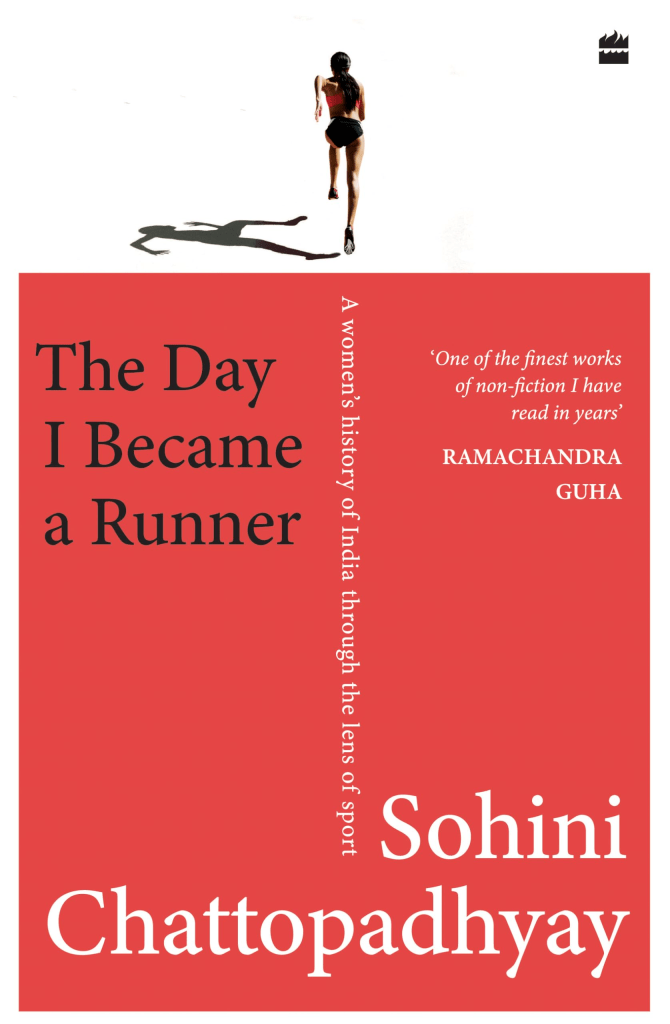
The Day I Became a Runner: A Women's History of India through the Lens of Sport by Sohini Chattopadhyay
Genre: Non fiction

In the opening chapter the author talks about taking up running as a means to deal with her grief. She narrates an incident where she’s on a running track and sees a group of men walking on the path. Even though they’re in her way, she changes her route to avoid them. I found myself in a similar situation in my building walking track, where a group of men were in my way and much like Sohini, I instinctively changed my course to avoid them.

Another thread she explores is how sport gives women a personhood. It gives her a right over something she’s been told she has no right over: her body. Almost all the athletes Sohini interviewed for the book talk about the training and nutrition that they needed to hone their bodies into hurtling machines.

My most favourite chapter was probably the one on PT Usha. PT Usha has almost a meme-esq quality for most of us where we conjure her any time we want to talk about speed or running. It’s remarkable that despite knowing who PT Usha is, this was the first time I was reading about her as an athlete, how she trained, the number of medals she earned and one of the reasons she was able to keep the sport in her life was that her husband didn’t mind keeping house while she trained.

PT Usha with her medals
PT Usha with her medals (source)

The book also reminded me of a controversy during the 2024 Olympics when news started circulating about a women’s boxing match where one athlete was accused of being a man, competing in the women’s category. There were reports of her having testosterone levels that were more in the range of what male athletes have than what was normal for a female body.

I remember reading the disturbing discourse that followed over gender and female athletes not looking feminine enough.

The Day I Became a Runner made me realize that it’s quite natural for female athletes to go through such accusations, to go through gender tests to determine if they’re female enough to compete in the female gender events.

It’s interesting that 3 of the 9 athletes that Sohini has talked about in the book have gone through tests to check their testosterone levels.

From the book, the test is a test of hyperandrogenism where a female body produces more androgens. It’s a hormone levels malfunction and while there arenโ€™t enough studies that prove having higher levels of testosterone give female athletes an edge over their opponents, it is still something that is done, with results being โ€œleakedโ€ to news agencies willy-nilly, without the consent of the athlete.

It made me question if the test is done only to ensure a level playing field? Because, as Sohini points out, height, wealth of a country, the kind of training an athlete receives in a first world country versus a third world country, none of these are considered unfair. Then why just a hormone level?

Is there perhaps a more sinister undertone to these gender tests? Perhaps to ascertain if you’re woman enough โ€“ considering you’re muscled and walk a certain way because of the control you have over your body โ€“ to enter into female category of sports?

The book was not only an eye-opening account of how apathetically we as a country look at sport but also how important it is for a female athlete to be in the limelight. That just by virtue of women running in shorts on a beach was a visual the men in her village got used to, it allowed other girls to step out of the house and do something different with their life.

It also made me realize that anyone who is in the limelight, need only be celebrated to the extent of what they (knowingly or unknowingly) achieved for their community and the world at large. Beyond that, it is not their job to live up to my standards or expectations.


This post is part of Bookish League blog hop hosted by Bohemian Bibliophile.

19 responses to “Not a book review: The Day I Became a Runner”

  1. In spite of icons like PT Usha, girls of our generation who were actively into sports were often treated as something of a misfit. Not surprised by the tests. Be it anything or everything, women are expected to prove they are women enough. I have seen this book around and will be picking it up soon.

    Liked by 1 person

    1. And the parameters of the proof are also not decided by them. Hope you enjoy the book!

      Like

  2. Your reflection is powerful and thought-provoking. The book sounds like an important and necessary read โ€” thank you for bringing its essence alive so vividly!

    Liked by 1 person

    1. Thanks Jaideep ๐Ÿ™‚

      Like

  3. The stories of Ila Mitra and Mary D’Souza in particular are milestones that mark the long and tortuous path that women are challenged or compelled to take and leave behind footprints in time,quite literally.They,for me, stitch together heroically, a past historically of India, just on the threshold and after independence.Generations, especially women would have cause to remember,it was never easy.And men to look into their ugly selves,beyond cricket and ogling at girls.

    I’m sure Sohini makes running for girls more attractive.And like my teachers in school used to urge girls to be more in numbers ,do it more and let the boys chase,applaud and go breathless.

    Like

    1. That’s true, we would all benefit from self introspection.

      Like

  4. Your reflection on the book beautifully captures the everyday struggles women face, from altering paths to questioning gender biases in sports. PT Ushaโ€™s story is inspiring, and the gender testing controversy is infuriating. Itโ€™s a reminder that womenโ€™s achievements deserve celebration, not scrutiny. What resonated with you the most?

    Liked by 1 person

    1. Thanks Kanchana. It was a wonderful read.

      Like

  5. There was a movie made on this very concept of higher testosterone levels in female athletes, starring Taapsee Pannu, called Rashmi Rocket.
    I’m not into non-fiction much but since I enjoyed that movie and based on your review of how eye-opening this book is, I might just give it a try. Also, totally agree on that last bit about focusing only on what that athlete achieved. I think it’s the same with separating the art from the artist theory, right?

    Liked by 1 person

    1. I hadn’t heard of the movie – let me check it out. And focusing on athlete achievement actually helped me make that difference between separating the art from the artist ๐Ÿ™‚

      Liked by 1 person

      1. Not great but good enough… the movie, I mean ๐Ÿ™‚

        Liked by 1 person

  6. Preeti Chauhan Avatar
    Preeti Chauhan

    With that raving recommendation from another favourite author Ram Chander Guha, I was already sold on this book, but the author’s confession that she took up running to deal with personal emotions also resonated with me.

    Having been an active runner though not professionally, most of the issues raised are familiar to me.Women in India do have to face far more challenges to compete , train and excel.The support of the family is crucial because sports needs dedication and money.

    Liked by 1 person

    1. This was such an easy breezy read for me too. Definitely worth giving a shot. And that’s so true, it takes a village to achieve any kind of success in any field.

      Like

  7. Most women of the generation before ours had very little agency so the idea of sports giving women a sense of self is interesting and empowering. The book sounds worth a read.

    Liked by 1 person

    1. That’s such a good point you have made Tulika! Thank you for sharing ๐Ÿ™‚

      Like

  8. The very opening sentence is catchy. Yes, it’s tough to be a woman in India. Worse, if you’re gifted in some way. We’re still an antiquated patriarchy with Brij Bhushans getting on with their crimes against women in their care.

    Liked by 1 person

    1. You’re so right. And thank you ๐Ÿ™‚

      Like

  9. From your post, I remembered the same happened with me. Though I was walking in another colony, but it was not fully empty, people were walking, and some grocery shops were open where customers were present. An aunty was teaching her students. Still, among the crowd, I chose to walk on a different path to avoid the group of boys who were coming towards me. I think this is a common scenario for every girl. This book is really an eye-opener for everyone.

    Liked by 1 person

    1. Indeed it was an eye-opening read ๐Ÿ™‚

      Like

Leave a reply to Suchita Cancel reply