
Being a woman in this world is an act of rebellion. While we’re taught we can be intelligent, kind, and accomplish anything we set our minds to, there is always an undercurrent of imminent threat to our lives.
This is one of the threads that The Day I Became a Runner: A Women’s History of India through the Lens of Sport by Sohini Chattopadhyay explores.
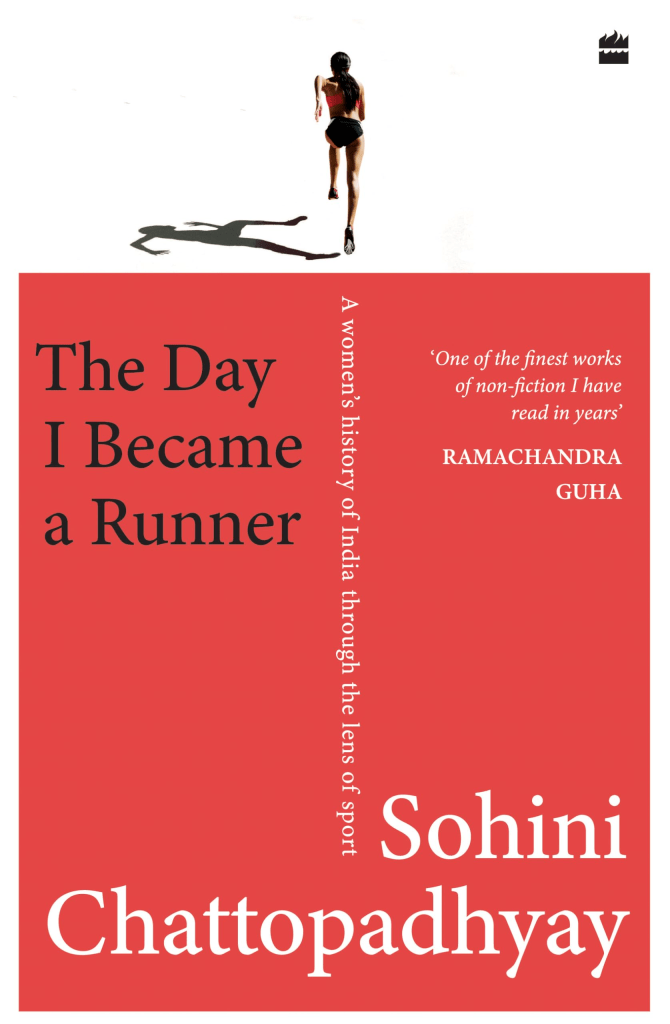
In the opening chapter the author talks about taking up running as a means to deal with her grief. She narrates an incident where she’s on a running track and sees a group of men walking on the path. Even though they’re in her way, she changes her route to avoid them. I found myself in a similar situation in my building walking track, where a group of men were in my way and much like Sohini, I instinctively changed my course to avoid them.
Another thread she explores is how sport gives women a personhood. It gives her a right over something she’s been told she has no right over: her body. Almost all the athletes Sohini interviewed for the book talk about the training and nutrition that they needed to hone their bodies into hurtling machines.
My most favourite chapter was probably the one on PT Usha. PT Usha has almost a meme-esq quality for most of us where we conjure her any time we want to talk about speed or running. It’s remarkable that despite knowing who PT Usha is, this was the first time I was reading about her as an athlete, how she trained, the number of medals she earned and one of the reasons she was able to keep the sport in her life was that her husband didn’t mind keeping house while she trained.

The book also reminded me of a controversy during the 2024 Olympics when news started circulating about a women’s boxing match where one athlete was accused of being a man, competing in the women’s category. There were reports of her having testosterone levels that were more in the range of what male athletes have than what was normal for a female body.
I remember reading the disturbing discourse that followed over gender and female athletes not looking feminine enough.
The Day I Became a Runner made me realize that it’s quite natural for female athletes to go through such accusations, to go through gender tests to determine if they’re female enough to compete in the female gender events.
It’s interesting that 3 of the 9 athletes that Sohini has talked about in the book have gone through tests to check their testosterone levels.
From the book, the test is a test of hyperandrogenism where a female body produces more androgens. It’s a hormone levels malfunction and while there aren’t enough studies that prove having higher levels of testosterone give female athletes an edge over their opponents, it is still something that is done, with results being “leaked” to news agencies willy-nilly, without the consent of the athlete.
It made me question if the test is done only to ensure a level playing field? Because, as Sohini points out, height, wealth of a country, the kind of training an athlete receives in a first world country versus a third world country, none of these are considered unfair. Then why just a hormone level?
Is there perhaps a more sinister undertone to these gender tests? Perhaps to ascertain if you’re woman enough – considering you’re muscled and walk a certain way because of the control you have over your body – to enter into female category of sports?
The book was not only an eye-opening account of how apathetically we as a country look at sport but also how important it is for a female athlete to be in the limelight. That just by virtue of women running in shorts on a beach was a visual the men in her village got used to, it allowed other girls to step out of the house and do something different with their life.
It also made me realize that anyone who is in the limelight, need only be celebrated to the extent of what they (knowingly or unknowingly) achieved for their community and the world at large. Beyond that, it is not their job to live up to my standards or expectations.
This post is part of Bookish League blog hop hosted by Bohemian Bibliophile.


 tales of Suchita
Leave a reply to PebbleGalaxy Cancel reply