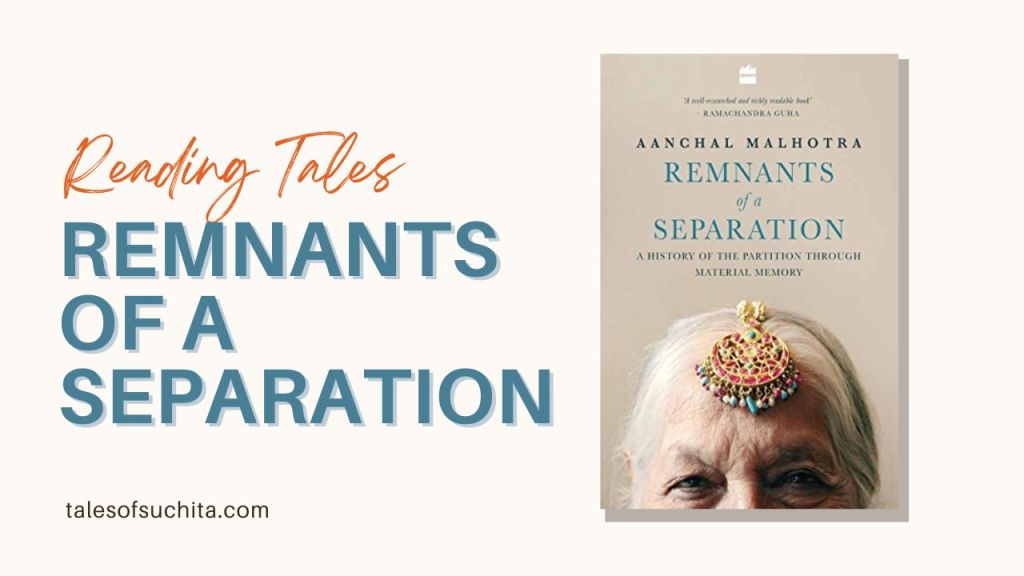
Home.
This is a word that’s always fascinated me. I don’t really understand what the word means so I look for how others define this word. It can mean people, or a city or a childhood home they grew up in.
But home in many instances boils down to a house or land – desh ki mitti – as some of the people in the book Remnants of a Separation call it.
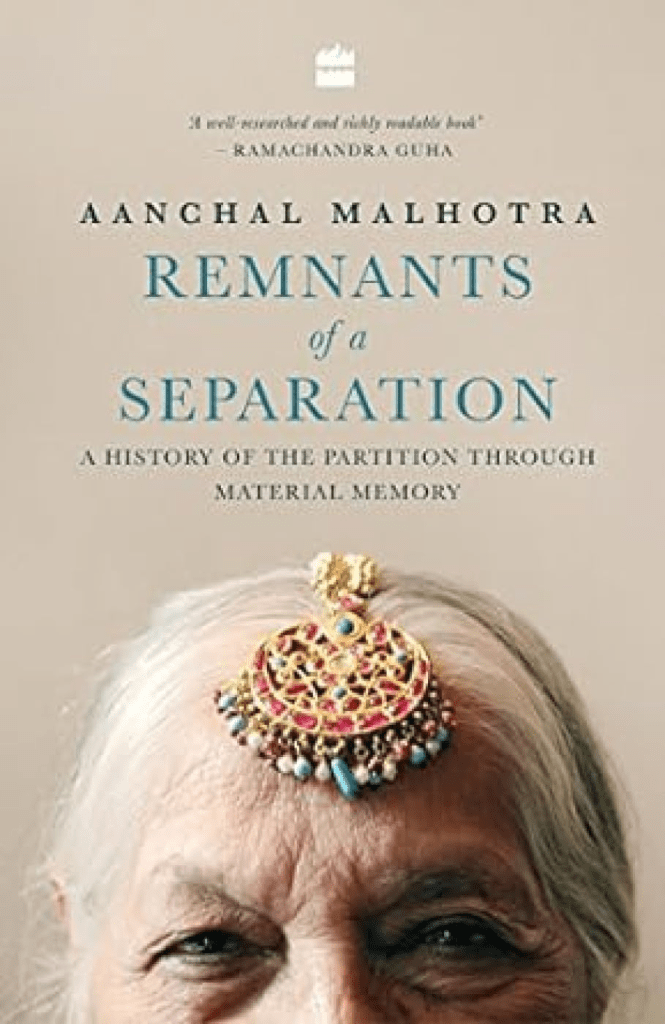
It’s interesting that despite being deeply curious about the partition and the history surrounding it, it has taken me so long to actually consume a piece of content around it. I usually steer clear of the topic because it always creates a visceral reaction of dread, fear and grief in me. What any of it means I don’t know. I just know how my body reacts to the topic.
But I have also always felt vaguely guilty for not engaging with partition. That I am choosing to wilfully ignore such an important part of my identity: both personal and political.
So, I picked up this non fiction book by Aanchal Malhotra. Partition has been so romanticised and weaponized in pop culture, with most fiction books focussing on the uncontained violence that this event led to, that a non fiction book about material memories, people and conversations felt like a “safe” entry point into the topic.
I was right. And wrong.
Right because Aanchal doesn’t have any agenda in the book. She is simply a recorder of stories as she hears them. She’s not interested in telling you what to think but to present to you first hand accounts of people who experienced the grief of being separated from their homeland, their place of birth.
Wrong because it was still absolutely devastating to read the accounts of the people in the book, their stories of who they were before the partition announcement, where they were when they first heard it and what happened next.
We didn’t believe it.
We thought we’d be back.
We left behind so much.
People who were friends became enemies.
Almost all stories have the above four refrains in some or the other way.
Home doesn’t have a concrete definition for me. It’s always been a vague understanding that I’m not there. That home is somewhere that is not accessible to me. Another sentiment that was repeated in the book, a resonance I had not expected to find.
I have highlighted many, many paragraphs in the book. But here is one that talks about home in the form of smells.
‘I told her the two things that remind me of home, of India, were both smells,’ he said with a distant look in his eyes. ‘The first is the scent of geeli mitti, earth after it had been watered by the maali or, even better, after it had rained.’
‘And the second thing I remember is the smell of my father’s leather boots when he’d come home from work in D.I. Khan.
The above two quotes are from Chapter 6.
It took me almost six months to finish this book, the longest I have ever taken to finish something. It wasn’t easy for me to read about how, rato raat, from one night to the next morning, an undivided India that didn’t care about religion or who prayed to whom or the distinct cultures, turned into a river of blood, violence and hatred.
I had thought by the end of reading the book, I would have an answer to my question: why, why did it happen and why did we choose violence over everything else?
The funny thing is, even the people who went through it didn’t have an answer. Even they didn’t know why people, who were just people, suddenly became Hindu, Muslim, Sikh and Sindhi.
This book was a marvel. I’m so glad I read it. I’m so glad I chose this way, people’s stories of home and objects that they carried with themselves to remind them of home, to learn more about partition. Maybe now, I can let myself off the hook for being squeamish about the topic.
Home.
What does home really mean when a line in the sand tells you this isn’t your home anymore? That the gods you worship are now the reason that you’re without a home and must make do with this other piece of land that’s like home but isn’t in fact home.
What is home?
This post is a part of ‘Real and Rhythm Blog Hop’ hosted by Manali Desai and Sukaina Majeed under #EveryConversationMatters.


 tales of Suchita
Leave a reply to lifestrialsandsuccesses Cancel reply