Reading tales: Remnants of a Separation

Home. 

This is a word that’s always fascinated me. I don’t really understand what the word means so I look for how others define this word. It can mean people, or a city or a childhood home they grew up in.

But home in many instances boils down to a house or land – desh ki mitti – as some of the people in the book Remnants of a Separation call it. 
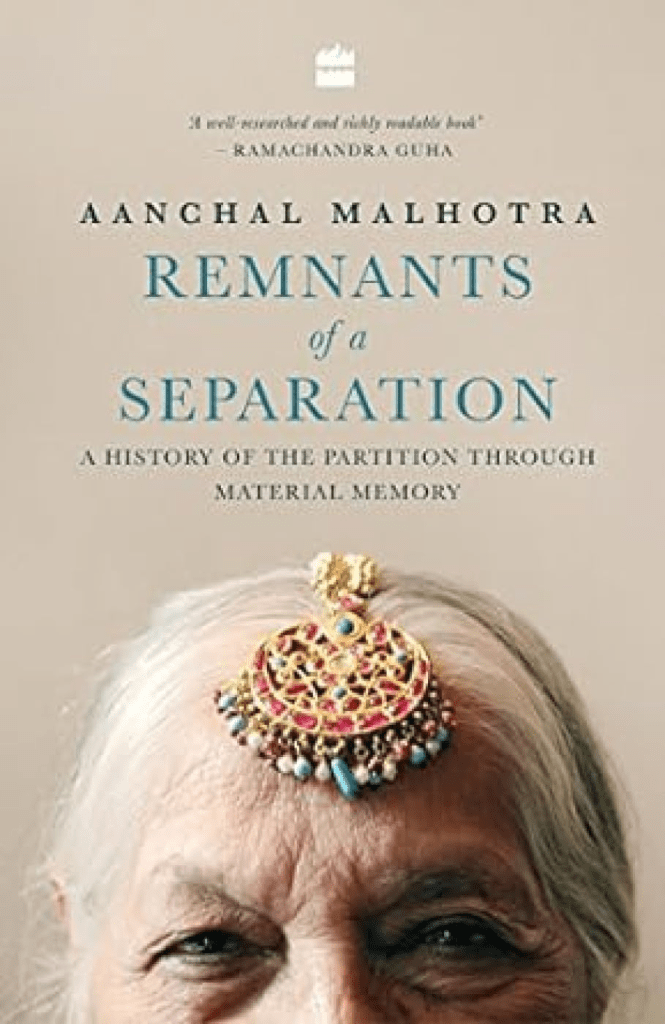
Remnants of a Separation: A History of the Partition through Material Memory by Aanchal Malhotra
Genre: Non fiction (history)

It’s interesting that despite being deeply curious about the partition and the history surrounding it, it has taken me so long to actually consume a piece of content around it. I usually steer clear of the topic because it always creates a visceral reaction of dread, fear and grief in me. What any of it means I don’t know. I just know how my body reacts to the topic. 

But I have also always felt vaguely guilty for not engaging with partition. That I am choosing to wilfully ignore such an important part of my identity: both personal and political.

So, I picked up this non fiction book by Aanchal Malhotra. Partition has been so romanticised and weaponized in pop culture, with most fiction books focussing on the uncontained violence that this event led to, that a non fiction book about material memories, people and conversations felt like a “safe” entry point into the topic.

I was right. And wrong. 

Right because Aanchal doesn’t have any agenda in the book. She is simply a recorder of stories as she hears them. She’s not interested in telling you what to think but to present to you first hand accounts of people who experienced the grief of being separated from their homeland, their place of birth. 

Wrong because it was still absolutely devastating to read the accounts of the people in the book, their stories of who they were before the partition announcement, where they were when they first heard it and what happened next. 

We didn’t believe it. 
We thought we’d be back. 
We left behind so much. 
People who were friends became enemies. 

Almost all stories have the above four refrains in some or the other way.

Home doesn’t have a concrete definition for me. It’s always been a vague understanding that I’m not there. That home is somewhere that is not accessible to me. Another sentiment that was repeated in the book, a resonance I had not expected to find.

I have highlighted many, many paragraphs in the book. But here is one that talks about home in the form of smells. 

‘I told her the two things that remind me of home, of India, were both smells,’ he said with a distant look in his eyes. ‘The first is the scent of geeli mitti, earth after it had been watered by the maali or, even better, after it had rained.’

‘And the second thing I remember is the smell of my father’s leather boots when he’d come home from work in D.I. Khan.

The above two quotes are from Chapter 6.

It took me almost six months to finish this book, the longest I have ever taken to finish something. It wasn’t easy for me to read about how, rato raat, from one night to the next morning, an undivided India that didn’t care about religion or who prayed to whom or the distinct cultures, turned into a river of blood, violence and hatred. 

I had thought by the end of reading the book, I would have an answer to my question: why, why did it happen and why did we choose violence over everything else?

The funny thing is, even the people who went through it didn’t have an answer. Even they didn’t know why people, who were just people, suddenly became Hindu, Muslim, Sikh and Sindhi.

This book was a marvel. I’m so glad I read it. I’m so glad I chose this way, people’s stories of home and objects that they carried with themselves to remind them of home, to learn more about partition. Maybe now, I can let myself off the hook for being squeamish about the topic. 

Home.

What does home really mean when a line in the sand tells you this isn’t your home anymore? That the gods you worship are now the reason that you’re without a home and must make do with this other piece of land that’s like home but isn’t in fact home. 

What is home?


This post is a part of ‘Real and Rhythm Blog Hop’ hosted by Manali Desai and Sukaina Majeed under #EveryConversationMatters.


59 responses to “Reading tales: Remnants of a Separation”

  1. the conclusion driven out is so true when one day the people suddenly became their religious identity. Really glad you read this book.

    Liked by 1 person

  2. Thanks for talking about this book and partition, Suchita. I loved reading your post. I love Aanchal’s writing and this one has been on my tbr. Time to start reading it.

    Liked by 1 person

    1. Thanks Rehana, this book is a gem 🙂

      Like

  3. That hit hard. And people like me would never understand the fact that raato raat when everything changes, the entire perspective changes. Sometimes, my father talks about the partition and how they saw their friendly Muslim neighbors being butchered one fine day, when religion became the cause for turning the best of friends into deadly enemies. Even I have never read any book on this; maybe there is some fear, but I cannot really define it.

    Liked by 1 person

    1. I totally understand that undefined fear. It’s a sad reality how fickle us humans are.

      Like

  4. Aurora Bluemoon Avatar
    Aurora Bluemoon

    Home! A big question and an answer too. This book is indeed a painful piece of memory shared on the pages. We build our home with everything until when? The sudden loss of so-called home and from unity to violence, I think this partition is still happening in every home in the name of property settlement… Wonderful piece of writing!

    Liked by 1 person

    1. Oh that’s such an interesting perspective and it’s so true. Thank you 🙂

      Like

  5. Okay, firstly.. loving the new layout of the blog

    and now, to this post… I’ve always been reluctant to read non fiction.. even in this sub genre of partition stories I’ve stuck to fictional stories.. sigh! Now you’ve convinced me otherwise…

    Liked by 1 person

    1. Thank you! I love the new layout too 🙂 And this book is worth trying.

      Liked by 1 person

    2. dnilshreeyahoocom Avatar
      dnilshreeyahoocom

      I have read Natasha Sharma’s Divided Beneath Skies, the only partition book in my reading list. And it only brings pain, I mean how did people survive those times and that era. I will read this one too, your review and experience compelling enough.

      Liked by 2 people

      1. Yes, their experience makes you question so many things. Hope you enjoy the book 🙂

        Like

  6. You read with your whole heart, and it shows. I love how you weave your own idea of “home” with the book’s memories, confronting pain without turning away. This feels like both a confession and a quiet reclaiming.

    Liked by 1 person

    1. Thanks Kanchan, that’s a cool observation 🙂

      Like

  7. I haven’t read much about partition for reasons you’ve mentioned here. It almost makes me feel guilty for being privileged enough to not experience the fear, displacement and helplessness that changed the lives of generations. Your wonderful review is encouraging me to give this book a read too.

    Liked by 1 person

    1. Guilty for the privilege – I hear you and I feel the same so many times in different circumstances.

      Liked by 1 person

  8. Partition in itself such a touchy topic, trying to understand the events or the aftermath another story altogether. Aanchal Malhotra’s writing indeed hits home, I’ve read her book ;The , Book of Everlasting Things, and loved it.

    Liked by 1 person

    1. That’s great – I have been meaning to read that book too 🙂

      Like

  9. The partition was an incident that left a deep scar on those who had to leave behind almost everything. What remains as their tales and anecdotes of sufferings, were their reality.

    Liked by 1 person

    1. That’s so true and this book brings that out beautifully.

      Like

  10. Stories about partition or for that matter war do move me a lot. To be honest , I have an uncomfortable feeling while reading such topics. But I think, the common point in any such extreme condition that gets destroyed is home which might mean the very identity of a person. Such books are really important as they showcase the reality. I loved reading your blogpost, Suchita!

    Liked by 1 person

    1. Yes, such books show you so much more than the glamour or valour of war. Thank you Chinmayee 🙂

      Liked by 1 person

  11. Some years ago, I gifted myself this book on my birthday. The stories of partition always feel home because I have heard such stories from my grandparents. This book is a gem!

    Liked by 1 person

    1. Those first-hand accounts must have been some listening experience.

      Like

  12. I’ve never had any love for religion, organised religion, though I am not an atheist. I believe in God, equality and normality and balance. But there are many stories like the India-Pakistan Partition from around the world, where home is a lost planet. I find these very distressing, take the case of Gaza, Ukraine, Holocaust, more recently I read a book Rohingya crisis. That’s why even though Partition is a closer arena, I can’t bring myself to read about it.

    Liked by 1 person

    1. Distressing – that’s the word I would also use when reading about war in any form. And I totally get why reading about it is difficult.

      Liked by 1 person

  13. Neha Parmar Avatar
    Neha Parmar

    I have never really given much thought to the partition or the political issues surrounding it, though I did struggle to fully grasp its impact when I saw something related to it in a movie. Your post feels similar—it didn’t exactly resonate with me, but it stirred up thoughts I hadn’t considered in a long time. I really appreciated how you not only provided a review but also sparked a chain of thought around the word ‘Home’ and the different perspectives surrounding it.

    Liked by 1 person

    1. Thanks Neha!

      Like

  14. This was beautiful to read. Your thoughts on ‘home’ linger long after the last line — just like the stories in Malhotra’s book. It’s amazing how you’ve distilled the pain, nostalgia, and quiet dignity of those memories into something so heartfelt. Loved this reflection.

    Liked by 1 person

    1. Thank you Neerja 🙂

      Like

  15. Six months! Wow! That’s a long time! I’m like this with TV series and maybe ‘To Kill a Mockingbird’! For me Home is Bombay. My family lives there but I live in Bangalore with my kids, hubby and mom. But still, Bombay just feels like home. Perhaps it is because I’ve spent 4 years of my childhood there?

    Like

    1. It takes me too much effort to get into video content too 😀 Ah Bombay…yes, as of now, it feels like home too.

      Like

  16. Your reflections on identity, loss, and the idea of ‘home’ echo the very ache the book leaves behind. It’s a thoughtful, moving take on a painful chapter of our past.

    Liked by 1 person

    1. Thanks Saadique. I’m glad what I wanted to say got translated.

      Like

  17. I have read and translated a book (non fiction) about the Partition. And it’s really heart wrenching. What makes it worse was how badly it was handled; rushed, poorly planned and terribly executed. They had enough time to organise it properly (and peacefully) and the timeline could have been extended, but politics and greed for power, you know.

    I haven’t read this book but your piece is very well written.

    Liked by 1 person

    1. Yes, humans and their many failings 😦 thank you Tarang, that means a lot.

      Liked by 1 person

  18. I remember reading this book during the Covid lockdown on kindle. When I had written a review for it ( because the book moved me so much) my father had said what was the reason to look at the past.

    I think books like these are important. They give value to the feelings of the common people who suffered for no fault of their’s.

    I loved your question of what is home. It holds such different meanings no?

    Liked by 1 person

    1. Your dad does have a point but Aanchal puts it quite well in the book that she needs to know her past to understand her present.

      Home does hold different meanings and the way people have described it is interesting.

      Like

  19. Those of us who grew up in the South may never understand the angst that surrounds the Partition. I realised some of its pain only as I grew up and watched movies and read novels on the theme. This may be also one reason why we lived in harmony here in South – until recently.

    Liked by 1 person

    1. Yes, it’s interesting how the rest of India dealt with the partition. I have read 2 fiction books set in Bombay that briefly touch upon the subject. The difference is quite stark.

      Like

  20. Deepti Menon Avatar
    Deepti Menon

    Suchita, it can be deeply painful to be uprooted from a place you call home, rato raat, and to be transported to a brand new space where everything you are used to exists no more. This book sounds different in that there are fewer accounts of violence and more about memories and the loss of possessions and Identity. I would love to read this book. Thank you for that!

    Liked by 1 person

    1. I hope you do and you enjoy it as much as I did 🙂

      Like

  21. I feel that reading real accounts of people is far more heart-wrenching than anything fiction or cinema can evoke. The raw, unfiltered emotions and the wounds that still ache speak louder than any crafted storyline ever could. Well, home, for me, is perhaps simply a place where I feel I belong—safe and at ease.

    Liked by 1 person

    1. I think what I appreciated about this book was that it did not have any agenda. Fiction, especially on this topic, can have those. Safe and at ease – that sounds nice.

      Like

  22. As someone who studied the era of freedom movement and partition extensively, I might have an answer for why it happened: It was a result of a few decades of political exploitation of people, by the British, the Muslim League (Mohammed Ali Jinnah), and the Indian National Congress (under Nehru and Gandhi). The British first partitioned Bengal and Punjab into east and west as part of their divide and rule policy, since these two were explosive regions, very easily ignited by the calls of independence and rebellion against British rule.

    Md Ali Jinnah, Nehru, and Gandhi took advantage of these divides and let Indians fight amongst themselves. Jinnah proposed the Two-Nation Theory – which states that Muslims and Hindus can never live in the same nation, both have to be in different nations – and the three collectively implemented this with British help. The three were so powerful in the country as freedom fighters and representatives of the Indians that common people simply followed them and it was a chain reaction from there. I hope this made sense.

    Did I answer your question? Let me know if you need more clarity or information.

    Liked by 1 person

    1. Thank you for the information. The politics I think is easy to figure out. What I question is the violence. But I suppose it’s natural to fight for your right to live.

      Liked by 1 person

      1. Yes. When threatened, people can react in extreme ways. I suspect violence was first started by politicians themselves.

        Liked by 1 person

  23. Preeti Chauhan Avatar
    Preeti Chauhan

    The topic of our partition remains heart wrenching despite having read about it many times.Nothing can prepare the heart to accept the barbarism, the inhuman acts and the overnight loss of trust in those we considered trustworthy. Home to me is a place I feel safe and secure in.

    Liked by 1 person

    1. That’s so true. It feels like a nightmare when you really think about it, not reality.

      Like

  24. You got me thinking. What do I mean by home? Having led a mostly nomadic life throughout, a gift for being a member of the Armed Forces, I reflect on the various structures I called home. What made them my home? Was it the same linen, curios, crockery, clothes, accessories, books etc. or was it the people who resided with me in those structures? Was it the same aroma of breakfast, lunch, and dinners, or the same perfume used by my mom, myself, and my hubby? Probably all of them!

    Liked by 1 person

    1. I relate to this. My dad also had a transferable job so we had numerous homes too. I like your view that home is a sum total of everything.

      Like

  25. They say, “home is where the heart is” When you leave one home and make another, you may have left behind your heart in the old home and make do with the memories or make every effort to embrace your ‘new home’ and create memories.

    Liked by 1 person

    1. That’s such an interesting thought. Thank you for sharing Marietta ❤

      Like

  26. I received this book as a Rakhi gift from my brother, and for the past three months, I’ve been reading it slowly, line by line—completely engrossed in the people and their thoughts. It’s not an easy book to read; I can only imagine how difficult it must have been for those who lived through those experiences. Remnants of Separation resonates deeply with me—not in the sense of separation, but through the memories of my ancestors, where simple objects carry stories, emotions, and sometimes an entire life within them.

    Liked by 1 person

    1. Objects can contain entire lives within them, a source of history. That’s so true. Hope you enjoy the book 🙂

      Like

    2. Home. It is such a small yet powerful word. Sometimes it means the world. I can’t even fathom the grief people must have gone through when they had to leave everything they knew, place that was a safe haven for them.

      Liked by 1 person

      1. Small yet powerful word – yes that’s exactly what a home is I think 🙂

        Like

  27. I read this book sometime back as part of a reading challenge, and ever since I’ve loved its cover, somehow it captured the weight of those stories and the dust of memory. True that, objects carry grief, absence, home in pieces . And yes in answer to your last question: home is both the place we remember and the place we’re trying to make, even when the original place is lost. I feel it’s the invisible line between memory and belonging.

    Liked by 1 person

    1. Between memory and belonging – I like that.

      Liked by 1 person

Leave a reply to Aurora Bluemoon Cancel reply